Content Writer
Most flowers bloom to be admired.
Rafflesia hasseltii blooms to disappear.
Hidden deep within Indonesia’s rainforests, this extraordinary flower spends years unseen, only to reveal itself for a few fleeting days. When it does, it leaves behind little more than a memory and a reminder of how fragile forest ecosystems truly are.
Rafflesia hasseltii: A Rare Bloom Hidden in Indonesia’s Forests
Often called the world’s largest flower, Rafflesia challenges nearly everything we think we know about plants. It has no leaves, no stems, and no roots. Instead, it survives as a parasite, living entirely inside the tissue of a forest vine.
For most of its life, Rafflesia remains invisible. There is no sign of its presence until, after years of waiting, a single bloom emerges on the forest floor, they are brief, dramatic, and easy to miss.
Indonesia is home to the greatest diversity of Rafflesia species on Earth. Of more than 40 species recorded across Southeast Asia, around 16–17 are found in Indonesia. Among them, Rafflesia hasseltii is one of the rarest.
A Life Spent Waiting of Rafflesia hasseltii
Rafflesia hasseltii grows slowly and depends entirely on a healthy forest ecosystem. As a holoparasitic plant, it draws all its nutrients from its host vine, usually a Tetrastigma species.
For two to three years, it exists unseen beneath layers of soil and leaf litter. Only then does a bud begin to form. When the flower finally opens, the change is striking.
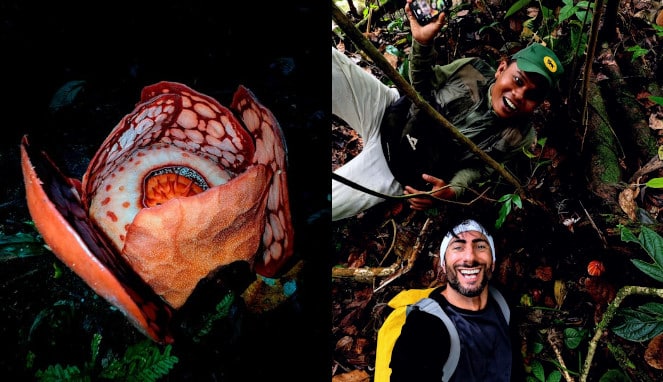
Its dark maroon petals, marked with irregular white blotches, spread wide across the forest floor. Measuring around 70 centimeters in diameter, it is smaller than Rafflesia arnoldii but no less dramatic. The bloom lasts just two to three days before beginning to decay.
On 18 November 2025, one such bloom was documented in Hiring Batang Sumi, a remote forest area in Sumpur Kudus District, Sijunjung Regency, West Sumatra.
The discovery was made by biologist Chris Thorogood from the University of Oxford, together with Septian Andriki, a local Rafflesia observer from Bengkulu, supported by Indonesian researchers and local forest managers.
Reaching the site required hours of trekking through dense rainforest, far from roads and settlements. The terrain is steep, and visibility is limited. Also, the forest lies within the natural range of the critically endangered Sumatran tiger, making research access both challenging and carefully controlled.
(source: Boombastis)
Why Rafflesia hasseltii Is So Rare
Rafflesia hasseltii cannot survive outside its natural habitat. It depends on intact rainforest conditions, stable soil, clean water systems, and the continued presence of its host vines.
Even in healthy forests, flowering is unpredictable. Buds may fail to develop, environmental conditions may shift, and years can pass without a single bloom. Its rarity reflects not only its biology, but also the fragility of the ecosystem it inhabits.
The presence of Rafflesia hasseltii in Hiring Batang Sumi suggests that the forest ecosystem remains intact. Soil fertility, microclimate stability, and biodiversity are still sufficient to support highly sensitive species.
Notably, this forest is not a formal conservation area. It is managed through community-based forest stewardship, demonstrating how local communities play a crucial role in preserving biodiversity beyond national parks.
Rafflesia hasseltii is legally protected under Indonesian Government Regulation No. 7 of 1999 and is listed as Endangered on the IUCN Red List. Across Southeast Asia, an estimated two-thirds of Rafflesia habitats lie outside protected areas.
A Bloom That Leaves a Message
Rafflesia hasseltii blooms without warning and fades just as quietly. Its brief appearance reminds us that some of nature’s most remarkable wonders are not meant to last, but to signal balance.
Protecting this flower ultimately means protecting Indonesia’s remaining rainforest ecosystems. Once the forest is gone, Rafflesia will disappear with it.
Writer: Farsya Sabila
Editor: Tesalonika Kristianti